
Dethatching gets sold as routine maintenance, something you schedule every spring the way you change a furnace filter. It is not. Most of the lawns we look at in Maple Grove and Plymouth do not need it in a given year, and doing it to a lawn that does not need it is a setback rather than a service.
So before anything else, here is how to find out whether yours is a candidate.
Go cut a plug and look at it
Take a spade, cut a wedge about three inches deep somewhere in the middle of the lawn, and lift it out.
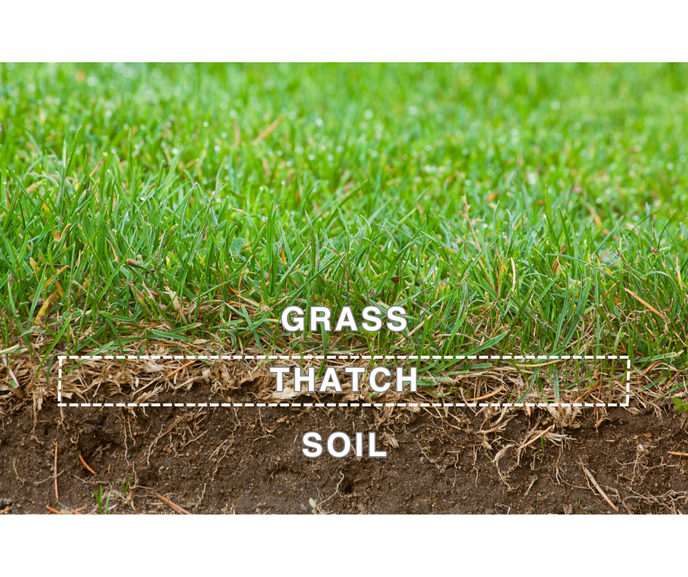
Between the green growth on top and the soil underneath you will see a spongy brown layer of stems, roots and old runners. That is thatch. Measure it.
Under half an inch, you are fine and there is nothing to do. Half an inch to three quarters, keep an eye on it. Past three quarters of an inch, and especially past an inch, you have a lawn that will respond to dethatching.
You can feel it too, without the spade. A lawn with a serious thatch layer is springy underfoot in a way that feels more like walking on a mat than on ground, and footprints hold their shape longer than they should.
A thin layer is doing you a favour
The instinct is that thatch is bad. It is only bad past a threshold.
A layer under half an inch behaves like organic mulch sitting on the soil surface. It holds moisture through July, buffers the roots against soil temperature swings, and still lets water, air and nutrients move through to the root zone. Strip that out and you have made the lawn more fragile, not healthier.
The problem starts when the layer gets dense enough to stop being permeable. At that point it works as a barrier instead of a blanket. Water sheets off or sits in the mat rather than reaching soil. Fertilizer lands in the thatch and feeds nothing. Air does not get down. The grass responds by rooting into the thatch layer itself instead of into soil, which is a shallow, drought-prone place to live, and the whole lawn gets more fragile in exactly the way a thick layer was supposed to prevent.
Why some lawns build it and others do not
Grass clippings are not the cause, which surprises people. Clippings are mostly water and break down quickly. Returning them is fine and we recommend it.
Thatch is built from the tougher, slower-decomposing parts of the plant: stems, crowns, roots and the lateral runners that Kentucky bluegrass throws. Anything that speeds up production or slows down decomposition moves a lawn toward a problem.
The usual contributors in the west metro are heavy nitrogen feeding that pushes more growth than the soil biology can process, compacted clay that starves the microbes doing the breakdown, and the low soil activity that comes with a short growing season. New construction lots around Rogers, Dayton and Otsego are worth watching in particular, because thin scraped topsoil over compacted subsoil is a slow decomposition environment.
Dethatching and aeration are not the same thing
This is the confusion we correct most often.
Dethatching is a surface operation. Tine rakes tear through the mat and pull the excess material up off the lawn so it can be collected. It is aggressive, it makes a mess, and the lawn looks rough for a couple of weeks afterwards before it fills back in.
Core aeration works the other direction. It pulls plugs of soil and thatch out of the ground and drops them on the surface, which relieves compaction, opens channels for water and air, and introduces soil microbes into the thatch layer where they help break it down.
For a mild layer, aeration alone is usually the better call. It is gentler, it addresses compaction at the same time, and it works the problem from underneath. For a genuinely heavy mat, aeration is not enough on its own and dethatching is the right tool.
If the lawn needs both, dethatching goes first and aeration follows, so the tines are reaching soil rather than working through a mat.
When to do it in Minnesota
Timing is not optional here. Dethatching is hard on a lawn, so it has to happen when cool season turf is actively growing and can recover.
That gives two windows. Early fall, roughly late August through September, is the better of the two, because the grass is growing strongly, weed pressure is dropping, and it pairs naturally with aeration and overseeding while there is still time to establish before freeze-up. Spring works as a second option once the lawn is actively growing and the soil has dried out enough to work.
Summer is the one to avoid. Opening up a heat-stressed lawn in July invites weeds into every gap and asks the turf to recover at the point in the year when it has the least capacity to do it.
Dethatching also clears out what a Minnesota winter leaves behind, which is a separate benefit we went through in three types of winter lawn damage and how dethatching fixes them.
Frequently asked questions
How do I know if my lawn needs dethatching?
Cut a three inch wedge out of the turf with a spade and measure the spongy brown layer between the green growth and the soil. Under half an inch needs nothing. Past three quarters of an inch, and especially past an inch, the lawn will benefit. A springy, mat-like feel underfoot is the informal version of the same test.
Is dethatching the same as aeration?
No. Dethatching tears the mat off the surface with tine rakes. Core aeration pulls plugs of soil and thatch out of the ground to relieve compaction and open channels for water and air. For a mild thatch layer aeration is usually the better choice, since it also addresses compaction and helps the layer break down naturally.
When is the best time to dethatch in the west metro?
Early fall, roughly late August through September, is the best window, because cool season turf is growing strongly and can recover before winter. Spring is a workable second option once the lawn is actively growing. Avoid summer, when a heat-stressed lawn recovers slowly and weeds move into every opening.
Do grass clippings cause thatch?
No. Clippings are mostly water and break down quickly, and returning them to the lawn is fine. Thatch comes from the slower-decomposing stems, crowns, roots and runners, and it builds up when growth outpaces decomposition.
How often should a lawn be dethatched?
Only when measurement says so, which for most west metro lawns is not annually. Dethatching a lawn with a healthy thin layer strips away something useful and sets the turf back.
What does the lawn look like afterwards?
Rough for a week or two. Dethatching pulls up a large volume of material and leaves the surface thin and torn looking before it fills in. That is normal, and it is why the timing matters so much: done in early fall, the lawn has the growing conditions to close back up quickly.