
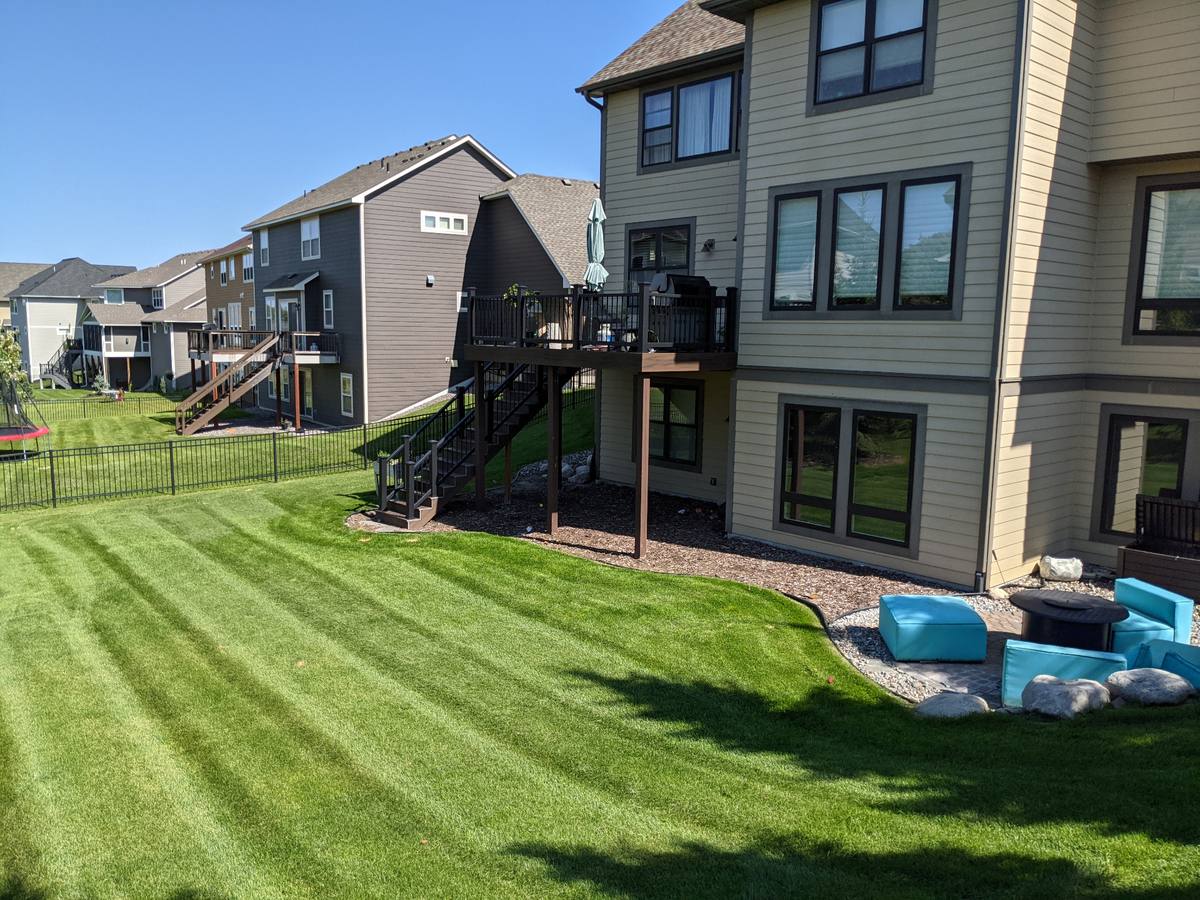
The last mow of the year usually gets treated as an afterthought. The mower goes in the shed on whatever nice weekend in October the homeowner decides the season is over, and the lawn takes it from there.
It is one of the few fall decisions that shows up clearly in April. Finish at the right height and the turf comes out of winter tight and green. Finish wrong in either direction and you are looking at matted gray patches or thin, scalped crowns while the neighbors are already mowing.
Here is how we handle the last cut on the Maple Grove, Plymouth, Corcoran and Rogers lawns we maintain.
Stop when the grass stops growing, not on a date
Cool season lawns in Minnesota keep growing well after the air starts feeling like winter. Kentucky bluegrass, perennial ryegrass, and fescue keep putting on top growth while soil temperatures hold near 50 degrees, and soil gives up its heat a lot slower than air does.
In practice the grass out here is usually still growing into the back half of October, and in a mild year it is still growing in early November. If it is growing, it needs to be cut. Parking the mower in early October because the calendar turned leaves the lawn to go under snow several inches taller than it should be.
Watch the mower, not the thermometer. Once you go two weeks and there is nothing meaningful to cut, you are done for the year.
How short: two to two and a half inches
Through the growing season we keep lawns in the two and a half to three inch range, which is what the University of Minnesota Extension recommends for cool season turf. Taller grass shades out weed seed, holds soil moisture, and supports deeper roots.
Winter is the one stretch where that logic flips. The last cut should land the lawn at roughly two to two and a half inches.
The reason is mechanical. Grass sitting at three inches or taller folds flat under the first wet snow, and a flattened layer of leaf tissue holds moisture against the crowns for months. That is the environment snow mold needs, and it is a large part of why one lawn on the block comes out of winter with matted patches and the lawn next door does not. Snow mold is one of the lawn diseases we see most across the west metro in April. Taller grass also gives voles a better runway to work in.
Cutting too short is the other failure. Anything under about two inches strips the leaf surface the plant needs to build and store energy before dormancy, and it leaves the crown exposed. A scalped lawn greens up slower and takes more winter damage, which shows up first on the windy edges of open lots in Rogers, Dayton and Corcoran.
Step down to it, do not scalp in one pass
The mistake we see most often is a lawn sitting at three and a half inches in late October getting taken straight down to two.
That breaks the one third rule, which says never remove more than a third of the blade in a single mowing. The rule applies all season and it does not get suspended because it happens to be the last cut. Taking half the plant off at once is a hard shock at the exact moment the grass is trying to move energy down into its roots.
Drop the deck one setting on each of the last two or three cuts instead. Three inches, then two and three quarters, then two and a half. It costs nothing, and the lawn never takes the hit.
Timing it in the west metro
Most years the last cut on our Plymouth and Maple Grove routes lands somewhere between the third week of October and the first half of November. It moves every season, and it is worth watching two things rather than the date.
The first is frost. Once we are getting hard frosts most mornings, top growth is close to finished even if the lawn still looks green at noon. The second is snow. The Twin Cities usually gets its first measurable snow in November, and in the years it arrives early the last mow simply does not happen for anyone who waited.
Sheltered yards behave differently from exposed ones. A fenced Plymouth backyard with mature trees holds warmth and keeps growing a little longer than an open lot on the north edge of Rogers or Dayton, where wind pulls heat out of the soil faster.
The rest of the last mow checklist
- Do not leave clippings in heavy rows. Returned evenly they feed the lawn, but a thick wet windrow mats down under snow the same way leaves do.
- Clear the leaves in the same pass or right after. Grass cut to the right height under a leaf blanket gets no benefit from the haircut.
- Sharpen or swap the blade if it has been a long season. A torn blade tip is an open wound heading into winter.
- Mow dry. Late fall lawns here hold dew until nearly midday, and cutting wet turf tears the blade instead of slicing it.
- Stay off frozen turf. Once there is frost on the grass, wait for it to lift. Driving over frozen blades breaks the cells and leaves tracks that are still visible in spring.
Where this fits with everything else
On the properties we maintain, the final cut is part of the fall cleanup visit, and that is deliberate. The last mow and the leaf removal have to land in roughly the same window to be worth much. Splitting them across three weeks usually means one of the two happens too late to help.
If you would rather hand the whole season off, that is what our west metro mowing service is for.
Frequently asked questions
How short should the last mow of the season be in Minnesota?
Finish the season with the lawn at about two to two and a half inches. That is shorter than the two and a half to three inches cool season turf should be kept at during the growing season. The lower final height keeps the grass from folding over and matting under snow, which is what leads to snow mold, while still leaving enough leaf surface that the plant is not scalped.
When is the last mow in Maple Grove and the west metro?
Usually between the third week of October and the first half of November for Maple Grove, Plymouth, Corcoran, Rogers and the surrounding towns, though it moves with the weather every year. The rule is to keep mowing as long as the grass is growing. Cool season turf keeps putting on top growth while soil temperatures stay near 50 degrees, which is often two or three weeks after the air stops feeling like fall.
Can I just take the lawn down to two inches in one cut?
Better not to. The one third rule applies to the last mow the same as every other mow, so never remove more than a third of the blade at once. Step the deck down one setting over the final two or three cuts so the lawn reaches its winter height without a shock.
What happens if I stop mowing too early?
The lawn keeps growing after you stop, then goes under snow several inches tall. Tall grass folds flat, holds moisture against the crowns all winter, and comes out in spring with matted gray or pink snow mold patches. It also hands voles the cover they need to tunnel across the lawn.
Should I bag the clippings on the last cut?
Returning clippings is useful for most of the season and stays fine on the last cut, as long as they scatter evenly. The trouble comes from heavy wet rows left sitting on the surface, which mat down under snow the same way a leaf layer does. If the mower is leaving visible clumps, bag it or make a second pass.
Does the last mow really change how the lawn looks in spring?
Yes, and it is one of the clearer cause and effect relationships in lawn care. Snow mold damage, vole runways, and slow spring green up all trace back in part to the height the lawn went into winter at. It is a free adjustment that pays off six months later.