
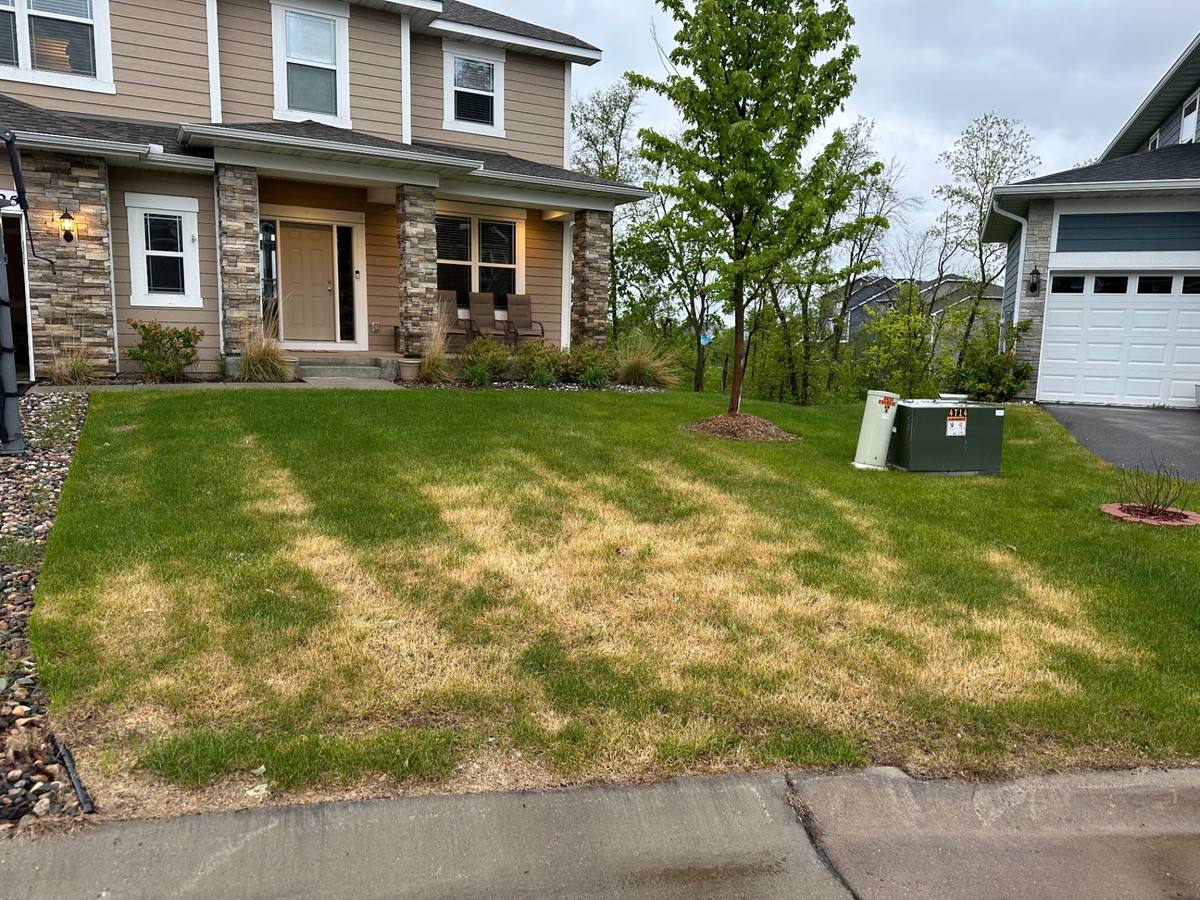
By the end of July, 76% of Minnesota was in drought. A week before that it was 48%. The Twin Cities metro slid from dry to moderate drought in seven days, and more than 95% of the state was at least abnormally dry.
You did not need the map to know. You could see it from the driveway.
The question worth answering now is whether the brown parts of your lawn are dead or asleep, because those two things look nearly identical from a distance and they call for completely different responses.
Dead or dormant: two tests that take a minute
The tug test. Grab a handful of brown grass and pull straight up, gently. Dormant grass resists. The crown is still anchored and the roots are still holding. Dead grass comes away in your hand with no effort at all, usually with a bit of dry soil attached.
The crown check. Part the canopy at soil level and look at the base of the plant, right where the blades meet the ground. That is the crown. If it still has a pale white or greenish tint, the plant is alive and waiting. If the crown is brown and brittle all the way through, that plant is gone.
Do both tests in several spots. Most lawns after a summer like this are a patchwork, alive in some areas and genuinely dead in others, and the pattern usually tells you why. Strips along driveways and sidewalks go first because concrete radiates heat. South-facing slopes go before shaded ground. A dry corner in an irrigation zone shows up as a clean geometric edge, which is a coverage problem rather than a drought problem.
Dormancy is the grass protecting itself
Kentucky bluegrass, which is most of what grows in west metro lawns, evolved to shut down when conditions turn against it. It stops pushing top growth, pulls resources into the crown, and waits. A healthy stand can hold that state for several weeks and green back up when the weather turns.
What actually kills a dormant lawn is indecision. A homeowner sees brown, runs the sprinklers for twenty minutes, decides it is not helping, and stops. Then does it again ten days later. Each of those shallow cycles pulls the plant part way out of dormancy and burns stored energy without delivering enough water to sustain the recovery. Breaking dormancy is expensive for the plant, and doing it repeatedly is worse than leaving the lawn alone entirely.
Pick one and commit. Either water it properly, meaning enough depth to reach the root zone on a consistent schedule, or let it stay dormant and plan to repair it in the fall. Both are defensible. The middle is what does the damage. Our Watering 101 post covers what depth and frequency actually look like.
What this summer did that you cannot see yet
Here is the part that matters more than the color.
Even where the grass survives, a drought thins the stand. Individual plants die, the canopy opens up, and bare soil ends up exposed between the survivors. That soil is not empty. It is full of weed seed that has been waiting for exactly this, and it will germinate next spring with no competition and nothing shading it.
So the real cost of this summer is not the brown you are looking at in August. It is the crabgrass and the clover you will be looking at next May, in a lawn that never got thick again.
That is the problem fall is for.
The repair sequence, and why the order matters
Water it back first. Nothing else works on a lawn that is still shut down. Grass that has gone dormant needs to come out of it before it can use anything you give it, and soil that has gone hydrophobic sheds water instead of absorbing it, so early cycles should be shorter and more frequent until it starts taking water again.
Then aerate. Drought-hardened soil compacts, and a season of mowing on dry ground makes it worse. Core aeration pulls plugs out and opens a path for water and roots. It also creates thousands of open holes for seed to land in, which is the whole reason the next step works.
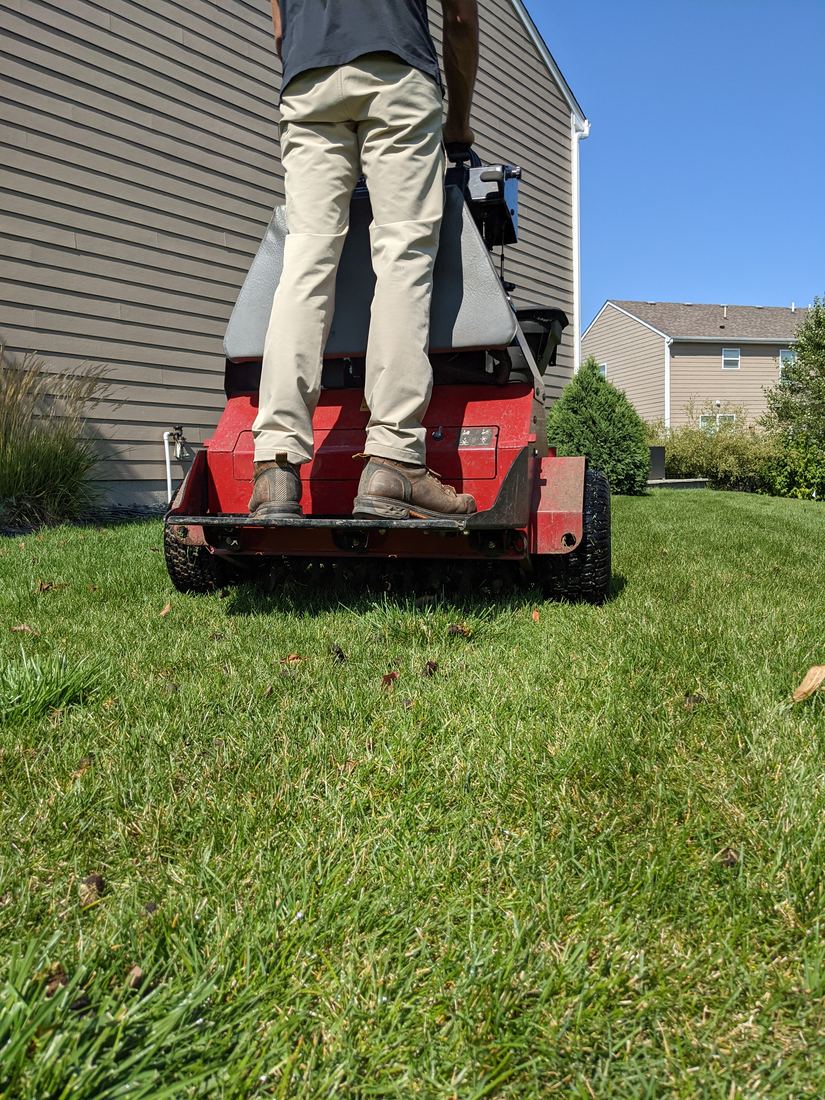
Then seed, heavily. We seed dormant and damaged areas hard rather than waiting to see what recovers. The logic is simple: we want the seed already sitting in the soil when the water finally arrives, whether that comes from a system or from the sky. Waiting to find out which plants pulled through wastes the best three weeks of the year.
Feeding stays on schedule. This is where we differ from a lot of the advice you will read, and it is worth explaining rather than glossing over. Plenty of articles will tell you to withhold fertilizer from a lawn with dormant patches. We do not change our program for that. The goal is for the nutrients to already be available in the soil at the moment water shows up, so that recovery starts immediately instead of waiting on another application. About 95% of our customers have irrigation, and those who do not are expected to water as if they do. This means water arrives on a schedule rather than on the weather's whim, and the nutrients should be there to meet it.
Once the water hits, the seed germinates and the dormant turf wakes up. Having nutrients already present turns that initial burst of hydration into rapid, thick canopy recovery before winter sets in.
Spread across a few weeks, that sequence rebuilds a lawn. Crammed into one Saturday, it mostly does not.
The calendar is the constraint
All of this runs into a hard deadline.
Grass seed needs warm soil and cooling air to establish, and it needs enough root mass to survive a Minnesota winter. That window is late summer, and it is closing. If you are reading this in mid September, you have days rather than weeks to get seed down with a good chance of it holding through winter.
We break the timing down in full, including what your options are if you miss it, in when to aerate and overseed your Minnesota lawn. If you only read one thing before booking, read that.
When a lawn is too far gone to patch
Sometimes the tug test comes back dead across most of the yard, and overseeding into dead thatch can be an uphill battle.
We do not install sod. If a lawn genuinely needs a full renovation we will say so and point you toward someone who does that work. But that verdict is rarer than homeowners expect after a hard summer, and it is worth being honest about why.
Most lawns that look finished in August are not. They are thin, compacted and full of gaps, and the combination that actually fixes them is core aeration and overseeding, backed by organic soil improvement where the soil itself is the limiting factor, and kept thick afterward by a real fertilization and weed control program. That sequence rebuilds far more lawns than it fails on.
The one thing that does not work is waiting until spring to deal with it. By then the weeds will have made the decision for you.
If you want someone to evaluate the property and tell you which parts are dormant, which parts are gone, and what it would take to bring it back, get in touch. We are on aeration routes across the west metro through mid-September.