
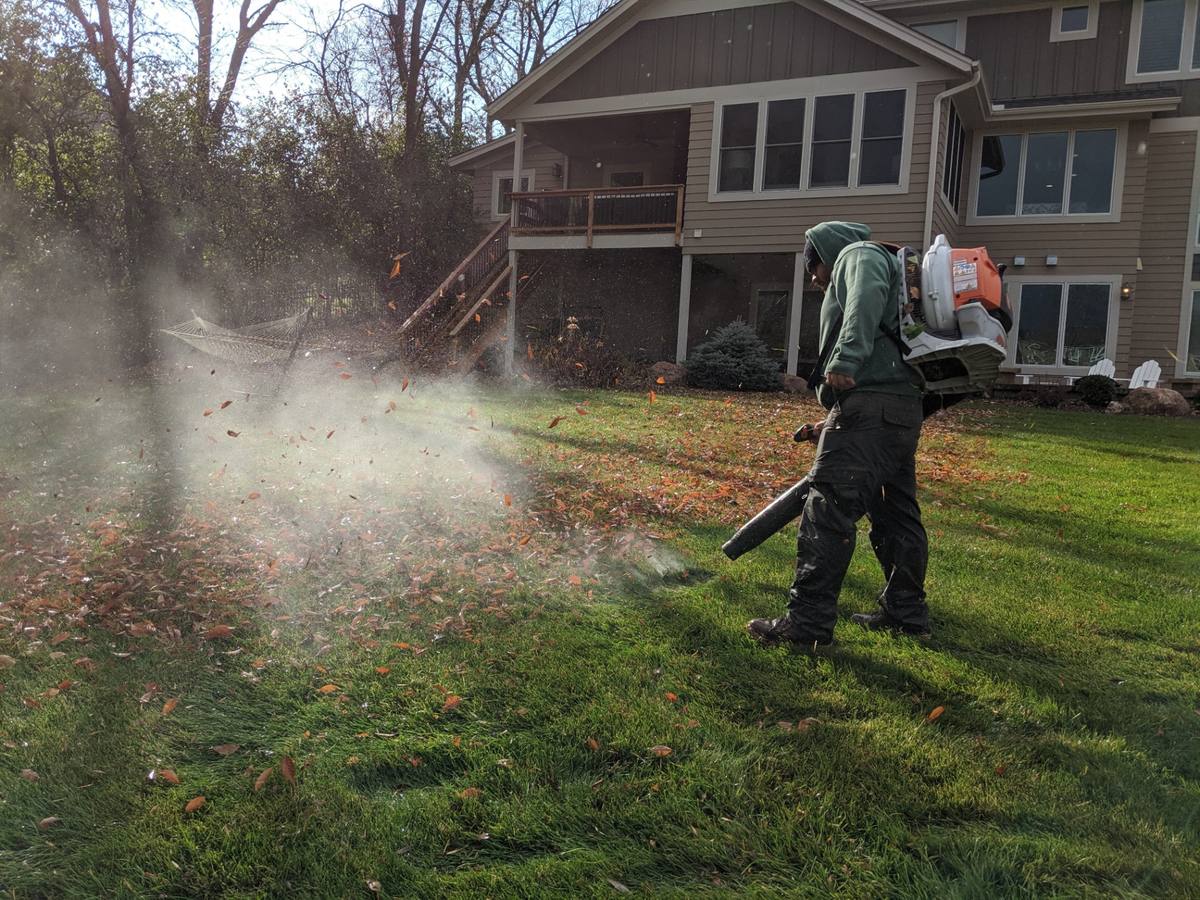
Every year the same call comes in around the third week of November. Someone looked out at a yard buried under wet leaves, checked the forecast, and realized the window had closed while they were not paying attention.
By then the ground is usually frozen and the leaves are frozen into it. What would have been a routine visit in October becomes a much harder job that mostly waits for April, and the lawn spends the whole winter under a wet mat.
We are based in Maple Grove and run cleanup routes across Plymouth, Corcoran, Dayton, Rogers, Champlin, Medina and the rest of the west metro. Here is the plain version of what the service covers, what it does for your turf, and why the calendar matters more than people expect out here.
What is actually included
A fall cleanup is more than leaf raking with a bigger crew. A full visit covers the whole property heading into winter:
- Complete leaf removal across turf, beds, and around the foundation
- A final mow at the right height for winter
- Bed clearing and perennial cutback
- Gutter blowout
- Blowing off the driveway, walks, and patio
- All debris hauled off site
That last line is worth reading twice. The debris leaves with the truck. It does not end up in bags at the curb waiting on your city collection schedule, and it does not get piled behind the garage. Crews run backpack blowers, truck loaders, and trailers, which is the difference between a property being cleared in one visit and a homeowner losing three Saturdays to it.
Leaf drop is not the same across the west metro
The calendar is roughly the same in every town we serve. Everything inside our service area sits within about twenty five miles, so Rogers and Plymouth are not on meaningfully different schedules. What changes from yard to yard is the trees, and that changes the job completely.
Established neighborhoods in Maple Grove and Plymouth were largely planted out in the 1980s and 1990s, and those boulevard maples and backyard oaks are now full grown. Those are the highest volume properties we touch, and they are also the ones most likely to need two passes.
Newer developments in Rogers, Dayton, and Otsego are the opposite. Young trees drop almost nothing. The problem on those lots is exposure. Open, windy new construction collects leaves from half the block, so the volume shows up even though the trees on the property did not produce it.
Larger lots in Corcoran, Greenfield, and Medina come with tree lines and acreage. Timing is easy there. Volume is the whole problem, and it is why those properties get scheduled with more crew time rather than more visits.
Then there are the properties backing onto park land. Homes along Elm Creek Park Reserve, around Fish Lake, or on the Medicine Lake side of Plymouth keep receiving leaves well after their own trees are bare, because the trees sending them over the property line are not theirs to rake.
Why a leaf layer causes real damage, not just a messy yard
Turf going into a Minnesota winter wants to be dry, short, and open to air. A leaf mat works against all three.
Wet leaves pressed flat by the first heavy snow hold moisture against the crown of the plant for months. That is close to ideal conditions for snow mold, which shows up in spring as matted gray or pink patches. Heavy cover also gives voles what they want, which is a protected runway between the soil and the snowpack. Vole damage is decided in the fall even though nobody sees it until the snow pulls back in April.
There is a simpler version of the same point. Grass that goes into winter smothered comes out of winter thin, and thin turf in April is an open door for crabgrass in May.
One cleanup or two
This is the question we get most, and your lot decides it.
Maple, ash, and birch tend to drop early and drop fast. A property with those trees and nothing else can usually be handled in a single visit once the canopy is mostly bare. Oaks are the complication. Oaks in this part of Minnesota hold their leaves well into November and some hang on all winter. If your Plymouth or Maple Grove lot has mature oaks, a cleanup booked for mid October will look great for about ten days and then you are back where you started.
The final mow does real work
Every fall cleanup includes a last cut, and the height on that cut matters. Grass left tall going into winter folds over under snow, stays wet, and mats. Grass taken too short loses the leaf surface it needs to store energy for spring. There is a right height and a right week for it, and both windows are narrower than people assume.
Our crews handle the final cut as part of the cleanup visit, so the timing lines up with the leaf work instead of being one more thing to remember.
When to book, and why September is the answer
Fall cleanup scheduling fills early here, and it is a capacity problem rather than a sales tactic.
The window in Minnesota is short. Most west metro properties need their final cleanup somewhere between mid October and the middle of November, depending on trees and weather. That is roughly four weeks of working days for an entire route, and an early snow can cut it shorter with no notice. The Twin Cities usually sees its first measurable snow in November, and some years it lands well before the last oak leaf does.
On top of that, the crews running cleanups are the same people who run our west metro snow routes. The moment the first plowable snow falls, cleanup capacity drops to whatever fits between events.
Getting a date in September is the difference between having your cleanup on the calendar and hoping there is room in the second week of November. If you want on the list, have a look at our cleanup service or reach out and tell us roughly how many trees you are dealing with.
Frequently asked questions
When should I book a fall cleanup in Maple Grove or Plymouth?
Book in September for a date in the mid October to mid November window. That is when most Maple Grove and Plymouth properties are ready, after the bulk of the leaves are down but before the ground freezes. Lots with mature oaks usually need a later date or a second visit, because oaks here hold their leaves into November. The working window across the west metro is only about four weeks long, which is why the calendar fills before the leaves do.
Which cities do you run fall cleanups in?
We cover Maple Grove, Plymouth, Corcoran, Dayton, Rogers, Champlin, Medina, Hamel, Loretto, Greenfield, Maple Plain, Long Lake, Orono, Wayzata, Hanover, Rockford, St. Michael, Albertville and Otsego. Our shop is in Maple Grove, so the northwest side of the metro is our home route.
What does a fall cleanup include?
A full fall cleanup covers complete leaf removal from turf and beds, a final mow, bed clearing and perennial cutback, gutter blowout, and blowing off the driveway, walks, and patio. All debris is hauled off site rather than bagged at the curb.
How much does a fall cleanup cost?
There is no flat rate, because the work scales with lot size, tree count, and how much leaf volume actually lands. A quarter acre lot in Rogers with two young maples is a very different job from a wooded acre in Medina with mature oaks. We measure properties using satellite imagery and quote from that, so you can get a real number without waiting on someone to walk your yard first.
Do I need one cleanup or two?
Your trees decide it. Maple, ash, and birch drop early enough that one well timed visit usually clears the property. Oaks, and lots that back up to woods or park land like Elm Creek Park Reserve, keep dropping into November, and those properties are typically better served by an early pass and a final pass.
What happens if leaves are left on the lawn over winter?
The leaf layer mats down under snow and holds moisture against the base of the grass for months. That sets up snow mold, gives voles cover to tunnel across the lawn, and leaves the turf thin in April, which is exactly when weeds get their opening. It is also a harder cleanup in spring than it would have been in fall.